Basic Measles Information
What is measles?
Measles (also called rubeola) is a very contagious virus and can cause serious illness. Measles spreads very easily when an infected person breathes, coughs or sneezes. Measles spreads so easily that anyone who is exposed and not immune (either by being vaccinated or having had measles in the past) will probably get it. The virus remains active and contagious in the air for up to 2 hours, even after an infected person leaves the room.
Who can get measles?
Anyone who has not been vaccinated or had measles in the past is at risk. Babies younger than 12 months are at risk because they are too young to have been vaccinated.
Measles was declared eliminated from the United States in 2000. However, since early 2025, U.S. measles cases have been increasing, and there have been several large outbreaks of more than 50 cases. Measles is also still common in many parts of the world. Every year, measles infections occur in the United States because unvaccinated travelers get measles while they are in other countries and then travel to the United States. These travelers are mostly Americans and sometimes international visitors.
How serious is measles?
Some people think of measles as just a little rash and fever that clear up in a few days. But measles can be dangerous, especially for babies and children who have serious complications.
What are the possible complications of measles?
Some people may suffer from severe complications, such as pneumonia (infection of the lungs) and encephalitis (swelling of the brain). They may need to be hospitalized and could die.
Complications from measles are more common among very young children (younger than five years), adults (older than 20 years), pregnant people, and people with weakened immune systems.
Common complications from measles are:
- Ear infections occur in about 1 out of every 10 children with measles.
- Diarrhea is reported in less than 1 out of 10 people with measles
Severe complications could include:
- Hospitalization. About 1 in 5 unvaccinated people in the U.S. who get measles is hospitalized.
- Pneumonia (infection of the lungs). As many as 1 out of every 20 children with measles gets pneumonia, the most common cause of death from measles in young children.
- Encephalitis (swelling of the brain). About 1 child out of every 1,000 who get measles will develop encephalitis (swelling of the brain). This can lead to convulsions and leave the child deaf or with intellectual disability.
- Death. Nearly 1 to 3 of every 1,000 children who become infected with measles will die from respiratory and neurologic complications.
- Complications during pregnancy. If you are pregnant and have not had the MMR vaccine, measles may cause a premature birth, or for you to have a low-birth-weight baby.
Long-term complications
- Subacute sclerosing panencephalitis (SSPE) is a very rare, but fatal disease of the central nervous system. SSPE develops from a measles virus infection earlier in life. It usually develops 7-10 years after a person has measles, even though that person seems to have fully recovered from measles. The risk of developing SSPE may be higher for a person who gets measles before age two (2). SSPE has rarely been reported in the U.S. due to high vaccination rates, but it is estimated from those who had measles in the U.S. in 1989-1991 (before it was eliminated in 2000), between 7 and 10 of every 100,000 people with measles were estimated to be at risk for developing SSPE.
What are the signs and symptoms of measles?
Measles symptoms appear 7-14 days after contact with the virus. Measles usually starts with:
- Fever, usually greater than 101°F
- Runny nose
- Cough
- Pink eye (red, watery eyes)
2-3 days after symptoms start, Koplik spots appear.
- Koplik spots are little white spots on the gums and inside of the cheeks
3-5 days after symptoms begin, a measles rash appears.
- Starts as flat red spots that appear on the face at the hairline.
- Spreads downward to the neck, trunk, arms, legs, and feet.
- Small, raised bumps may also appear on top of the flat red spots.
- The spots may become joined together as they spread from the head to the rest of the body.
- When the rash appears, a person’s fever may spike to more than 104°F.
People can spread measles before they show symptoms. Symptoms usually last from 7-10 days.
When do symptoms start?
It takes an average of 7-14 days from exposure before the first symptom begins, which is usually fever. The measles rash doesn’t usually appear until about 14 days after exposure, 2–3 days after the fever begins.
How long is a person with measles contagious?
Measles spreads very easily and can be spread from 4 days before the rash becomes visible to 4 days after the rash appears.
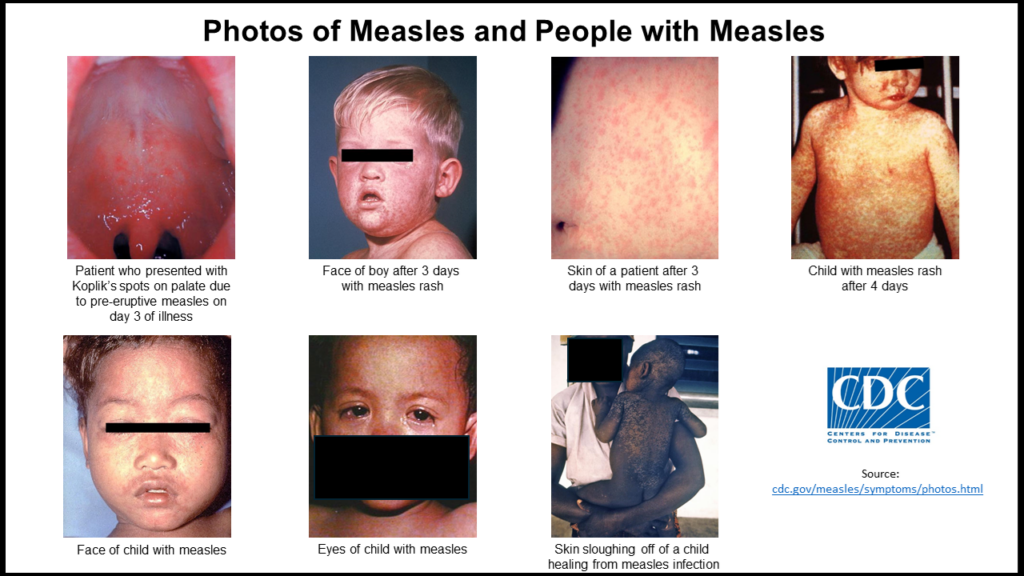
What does a measles rash look like?
The following photos of measles have been provided by the CDC.
What should be done if someone is exposed to measles?
Individuals should isolate at home and contact their healthcare provider for guidance about testing and isolation. Call the healthcare facility before going to make sure they know that you might have measles. This is so that the facility can take safety measures to prevent spreading measles to others. Do not go to a health care facility or office without calling ahead first.
What if someone in my family has measles?
The person should stay isolated from you and others for 4 days after their rash first appeared. It is best to limit contact with others in your household, and all family members should review their vaccination records.
How is measles diagnosed?
Measles is diagnosed by a combination of the patient’s symptoms and by laboratory tests.
Is there a treatment for measles?
There is no specific treatment for measles. People with measles need bed rest, fluids, and to control their fever. Patients with complications may need specific treatment.
Is there another name for measles?
Some other names used for measles include rubeola, 10-day measles, hard measles, and red measles. If you have had one of these, you are protected against measles.
If you have been told by a doctor that you had German Measles, 3-day measles, or soft-measles, you have protection against Rubella, which is a different virus than measles. You can still get measles.
Can someone get measles more than once?
No.
Prevention
How is measles prevented?
The measles, mumps, and rubella (MMR) vaccine is very safe, effective and the best protection against measles. Two doses of MMR vaccine are about 97% effective at preventing measles. One dose is about 93% effective. Serious reactions are extremely rare.
Who needs the measles vaccine (MMR)?
Children – Children should receive two doses of MMR vaccine, starting with the first dose at 12-15 months of age and the second dose at 4-6 years of age or at least 28 days following the first dose.
Students at Post-High School Educational Institutions (college, university, technical schools) – Students at post-high school educational institutions who have not had measles and have not been vaccinated need two doses of MMR vaccine with the second dose given no earlier than 28 days after the first dose.
Adults – People who were born after 1957 who have never had measles or have never had the vaccine should get at least one dose of MMR vaccine.
International Travelers – People 6 months of age or older who will be traveling internationally should be vaccinated against measles.
Who shouldn’t get vaccinated?
Some people should not get the MMR vaccine, or they should wait until they have spoken with their doctor or healthcare provider. This includes people who:
- Have had an allergic reaction after a dose of MMR or MMRV vaccine, or who have any severe, life-threatening allergies.
- Are or may be pregnant. Wait to get MMR vaccine until after you are no longer pregnant. Avoid getting pregnant for at least 1 month after getting MMR vaccine.
- Have a weakened immune system due to disease or medical treatments; or have a family member with a history of immune system problems.
- Have ever had a condition that makes them bruise or bleed easily.
- Have recently had a blood transfusion or received other blood products. You might be advised to postpone MMR vaccination for 3 months or more.
- Have tuberculosis.
- Have gotten any other vaccines in the past 4 weeks.
- Are feeling sick or severely ill. Your doctor can advise you.
Is the measles vaccine safe?
Research has shown that the measles vaccine (MMR) is safe and very effective. Getting vaccinated is much safer than getting any of the diseases the vaccine protects against.
Are there side effects from the vaccine?
Like any medication, the measles vaccine (MMR) may cause side effects, most of which are mild and go away on their own:
- Pain at the injection site
- Fever
- Mild rash
- Swollen glands in the cheek or neck
Does the MMR vaccine cause autism?
There is no link between the MMR vaccine and autism. Scientists in the U.S. and other countries have carefully studied the MMR vaccine. None have found a link between autism and the MMR vaccine.
It is safe for breastfeeding women to receive MMR vaccination. Breastfeeding does not interfere with the response to MMR vaccine, and the baby will not be affected by the vaccine through breast milk.
Does Vitamin A prevent measles?
Vitamin A does not prevent measles; only the MMR vaccine can prevent measles. Vitamin A should not be used to try to prevent measles, nor should it be used in high dosages, as it can lead to toxicity, which can cause nausea, vomiting, headache, fatigue, joint and bone pain, blurry vision, skin/hair problems, increased intracranial pressure, liver damage, confusion, coma, etc.
Should pregnant people get the measles vaccine (MMR)?
Pregnant people should not get the MMR vaccine. Pregnant people who need the vaccine should wait until after giving birth. People should avoid getting pregnant for four weeks after getting the MMR vaccine.
How do I protect my baby who is under 12 months old?
Newborns have some natural immunity from their mothers, if the mother was vaccinated, for the first few months of their life. If parents or caregivers have not gotten the MMR vaccine or had measles in the past, they should get vaccinated. It is important to make sure people who are around your new baby do not expose your baby to measles.
What should I do if I’m unsure whether I’m immune to measles?
If you’re not sure whether you’re immune to measles, you should first try to find your vaccination records or documentation of measles immunity. If you are not able to find your records, you may receive a dose of MMR if you are not currently required to quarantine and do not have a condition that would prevent you from getting a vaccine with a live virus vaccine (such as pregnancy or a severe immune disorder). If you are unsure that have any conditions that would prevent you from receiving the vaccine, you should reach out to your healthcare provider for further guidance. Another option is to have a doctor test your blood to determine whether you’re immune, but this option is likely to cost more and it may take some time to get the results.
How can I locate my immunization records?
Contact your health care provider about your vaccination history. Schools, colleges, prior employers, or the military (if you were enlisted) may also have records of your vaccination history. If you are, or have been, pregnant, your obstetrician’s office may have also tested you for immunity to measles when they tested you for immunity to rubella. You may also be included in your state’s immunization registry, which your local health department may be able to use to find these records. Please visit the United States Centers for Disease Control and Prevention’s (CDC) website for additional suggestions on how to find your vaccination records: https://www.cdc.gov/vaccines-adults/recommended-vaccines/keeping-vaccine-records-up-to-date.html?CDC_AAref_Val=https://www.cdc.gov/vaccines/adults/vaccination-records.html
Where can I get a measles vaccine?
The measles vaccine (MMR vaccine) is available at many primary care practices, pharmacies, and Signature Health. If you are not sure if you need a measles vaccine or if your series if complete, you should reach out to your healthcare provider.
Isolation and Quarantine
What is isolation?
Isolation separates people who are sick with a contagious disease from people who are not sick to stop the disease from spreading. People who have measles infection, or who are suspected of having measles infection, must be isolated until 4 days after their rash appeared to prevent spreading measles to other people. Isolation is an important part of stopping measles spread in the community, especially to people who are at risk of serious health issues from measles.
What is quarantine?
Quarantine means staying at home and away from daycare/school/work, group and social activities, sports and recreation events and public places like cinemas and shopping malls. Quarantine separates people who were exposed to a contagious disease and are in the time period where they could still get sick from it. People who have come into contact with measles may spread measles to others even before they have symptoms themselves. Quarantine helps prevent measles from spreading in the community. For measles, quarantine is 21 – 28 days from exposure to a person with measles.
Is school exclusion the same as quarantine?
No. The processes of quarantine and school exclusion are different and carried out separately.
Quarantine is a health department requirement that separates and restricts the movement of people of any age who were exposed to a contagious disease, and are in the period where they could still get sick from it. Public health authorities help determine the need for quarantine and how long a person should be in quarantine. For measles, quarantine is 21 -28 days from exposure to a person with measles.
School Exclusion is a State of Ohio rule that applies to school districts that requires their individual K-12 schools to exclude unvaccinated students from school for 21 days from the last reported case of measles in that school. The exclusion period is done for the protection of the unvaccinated student, is required by the State of Ohio, and is not optional for the school or the students. School exclusion does not apply to unvaccinated staff or faculty, but the quarantine period does apply. It should be noted that if there are multiple cases of the measles at a particular school, the student’s exclusion might be significantly extended beyond 21 days, since the 21-day time period would start again when a new case is identified. When a student is excluded from school, this exclusion also includes all before and after school activities, including childcare, clubs, and sports.
For more information about measles, please visit the following websites:
U.S. Centers for Disease Control and Prevention (CDC) Measles
Ohio Department of Health (ODH) Infectious Disease Control Manual (IDCM) Measles Chapter
ODH Director’s Journal School Requirement Information
American Academy of Pediatrics (AAP) Red Book Measles Information
Last Reviewed/Updated: 7/29/2026